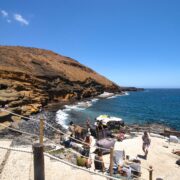
Sunny Tenerife attracts not only tourists but also those who dream of starting a new life here. If the idea of year-round warmth, beautiful beaches and a relaxed lifestyle appeals to you, Tenerife could be the place for you.
But what does all that change involve? How to find a job, where to start looking, and what to prepare for in order to make a living on the island? In this article, we give you practical advice and tips on how to take the first steps when moving to Tenerife and what to consider when planning this big life change.

Searching for a Job in Tenerife Step-by-Step
1. Getting NIE number
Although it is possible to work in any member state within the EU, it is not possible to do so in Spain without the proper administrative procedures. The first thing that needs to be done is to apply for an NIE (Número de Identidad de Extranjero). This is a unique foreigner identification number that must be applied for within 3 months of entering Spain. To do this, an appointment must be made with the local police. You can find out more about the NIE here (insert link to word ,,here’’ to page ,,Getting NIE number’’) .We will also be happy to help you with arranging the NIE.
An NIE is needed for all administrative tasks in Tenerife. Without it, the authorities simply won’t deal with you. It also serves as a foreigner’s tax number.
2. Registration of residence – empadronamiento
When you are a long-term resident, you must also declare and register your place of residence with the local government. The address of your residence is evidenced by a rental contract, proof of ownership of the property or a document that includes a certificate of residence from the person you are staying with. You will also need your NIE number and passport to process your empadronamiento.
3. Job search
The process of finding a new job can be challenging both at home and abroad. What kind of job you find depends partly on your qualifications and preferences.
In general, there are two types of jobs in Spain – unregulated and regulated.
Unregulated jobs are those that you can do under the same conditions as Spanish citizens.
Regulated professions are the types of positions for which special legal requirements apply in Spain. These include, for example, degree and field of education, length of experience or medical fitness. Knowledge of the language may also be required to practise certain professions. You can have your professional qualifications recognised by the relevant authority.
Most job offers are in tourism. There is a high seasonal turnover of employees, so new offers are almost constantly appearing.
We will discuss how to specifically look for a job later in the article.
4. Job interviews and obtaining a green card
After sending out your CV, you will start attending various interviews. This is where you may encounter your first problems. To work in Tenerife it is not enough to have just an NIE number, you also need to have a so-called green card, which is your long-term residence permit.
It may happen that a company or hotel will not want to employ you without this card. However, there is a catch. You will only get your green card at the office after you have presented your work contract in Spain. So you’ll find yourself in a bit of a conundrum. In practice, the situation can be resolved by having the Spanish employer issue a future contract agreement on the basis of which the authority will issue the green card. Unfortunately, not all employers are willing to take this extra step.

5. Opting out of health and social insurance in your home country
If you start working in another EU/EEA country, you will be required to notify your health insurance company and opt out. The exact procedure varies from country to country.
Afterwards, it is possible to enrol in the Spanish public health system and become a health insured person in Tenerife. Along with this, you will also be enrolled in the social security system, to which every worker is obliged to contribute through deductions from their salary.
6. Paying income tax
Income tax is deducted by the employer from your gross salary. Spain operates a progressive tax system, the parameters of which are as follows (as of 2025):
| Annual income from | Annual income to | Percentage of taxation |
| €0 | €12 450 | 19 % |
| €12 450 | €20 200 | 24 % |
| €20 200 | €35 200 | 30 % |
| €35 200 | €60 000 | 37 % |
| €60 000 and more | 45 % |
7. Loss of employment / termination of employment
If you lose your job in Tenerife, you may be entitled to unemployment benefits thanks to social security contributions. You must register with the local employment office within 15 days of leaving your job.
If you decide to return to your home country and find work here, you can apply for a transfer of unemployment benefits to your home country for up to 3 months after 4 weeks of registration with the Spanish employment office. Your benefits will be calculated according to your last employer (if you have worked the required number of months to qualify for unemployment benefits). This process has to be arranged by the Labour Office with the Spanish side, who will provide them with information about the claimant’s income.
Once you have stopped working abroad, you must also notify the health insurance company in your country and re-register with the national insurance system. At the same time, you must provide proof of the period of insurance abroad so that you are not required to pay additional premiums retrospectively.
At the end of your employment, you must receive: a certificate of employment – “Certificado de empresa”, a certificate of social security contributions – “los documentos de cotización” and a “finiquito” – a certificate of settlement of financial obligations.

How to Find a Job in Tenerife
1. Employment agencies
Jobs in Tenerife can be found through the help of one of the employment agencies. This is particularly useful if you want to save yourself the trouble of finding and approaching employers. However, it may mean that a position offered through an employment agency will be less well paid.
2. Online job portals
You can start your search on a job portal website. The biggest portals are InfoJobs or Monster.es. Another global job site is Indeed.
3. Facebook groups
One of the best ways to find jobs in Tenerife is through Facebook groups, especially if you are looking for a job in the service industry. Due to seasonality, positions become available very often here.
You can try groups like Jobs in Tenerife, Wanted Tenerife, Giz a job Tenerife, Tenerife Expats & Local, Tenerife Job Opportunity, Extra Jobs in Tenerife, Tenerife Jobs, Restaurant Jobs Tenerife, etc. You can also post an ad in the groups that you are looking for a job.
4. Addressing the employer directly
If you have a clear idea of who you would like to work for, you can visit the careers section of a potential employer’s website to find out about current vacancies. For jobs in the travel industry, you can also go to nearby businesses to see if they are looking for help.
5. Networking
You can also find your new employer through networking. Ask around for opportunities your contacts on LinkedIn or at industry trade shows and conferences. If you know someone who already lives in Tenerife, don’t hesitate to contact them. He or she will probably be more aware of the current opportunities.
Public Employment Services
The Spanish Public Employment Service (SEPE) or EURES, the official European portal for professional mobility, can also help you find a job, including job offers in Spain.
Other ways to find a job
Other ways to find a job in Tenerife include advertising in local newspapers or making contacts through professional organisations, language schools or volunteer placements. It is often the case that a local member knows an employer who could use a hand.
If you have special skills and know-how to support you, you can also try to run a business in Tenerife on a trade certificate, called an autónomo, which will give you a green card; however, you must take into account that you will have to deal with all the taxes yourself.

Salaries and Cost of Living in Tenerife
Salaries in Spain are usually paid monthly. In tourism and jobs where tips are part of the salary, the frequency of payment may vary, e.g. weekly. The minimum gross wage for a full-time job (40 hours per week) is €1,134 for 14 monthly payments per year and €1,323 for 12 payments per year. This means that the hourly minimum wage is €8.28.
Working in tourism, your wage will be around the minimum wage values.
Prices here are comparable to the Czech Republic, but in some cases living in Tenerife is cheaper. Some examples:
| Eating in an average restaurant | 15 € |
| Draft beer | 2,50 € |
| 12 eggs | 2,56 € |
| 1 kg chicken cutlets | 6,67 € |
| 1 litre of petrol | 1,44 € |
| Electricity and sewerage costs (85 m²) | 77,80 € |
| Rent of a one-room apartment in the centre | 1000 € |
The Biggest Difference in Costs – the Price of Real Estate
Tenerife is affordable especially when you buy your own property. Prices per m² are up to 70% lower than in the Czech Republic. However, their value is increasing every year, so now is the ideal time to invest here. If you are one of those who are thinking of buying a property in Tenerife, please contact us. We will be happy to get in touch so that together we can find the right investment for you!